Showing posts with label glazing with watercolours. Show all posts

May 4, 2025

6 Steps to Mixing Watercolours on Paper - Painting & Drawing Tips

Are your Paints just not working for you?
You mix away but you can't get the colour you want.  It needs to be a bit blue, but has yellow tones and is light and dark in places.  HOW CAN YOU MIX THAT!!??

Scarlet Macaw - 5 x 8, Watercolour 

I like to paint nature which includes both foliage but also the birds and animals that live there.  My work has a realistic look.  I achieve this by creating subjects that have mass and shape.  They bend and curve like they are 3 dimensional.  To do that I need to mix that "bit of blue, that has yellow tones and is light and dark in places". The colour changes have to be subtle and gradual, to create that realistic look.  
************
There is further discussion on this topic on my YouTube post: The Magic of Mixing Watercolour on Paper
************
To create these colour changes you will not always be able to find your answer mixing paint in your pallet.  You need to move onto your paper and get help there. 

You will find mixing your Watercolours on paper, opens up a whole new world of colour. Well it did for me and I hope it does for you as well.  
There are many different ways that this 'mixing' can occur but today I am going to focus on a method I use a lot.  

Lets have a look at the process 

1.  Underpainting emphasizing some of the colour changes on the body

Take a look at my Scarlett Macaw.  (Just got back from Mexico 😉and loved getting shots of this guy)
I have first of all painted an underpainting on him to set up the colours I want to emphasis in each area.  Once they are totally dry I can proceed. For purposes of my discussion I will focus on his chest.  

But first a word about Watercolours.  They have tons of secrets.  One secrete is about transparent colours.  This means when you paint over something with a transparent colour you can see the colour underneath. 
2. A Second Layer of red is painted over the chest - Note underpainting still showing

This is often referred to glazing with watercolours.  For a true glazing technique, the colour painted on top is a very thin (weak) layer and makes only a slight colour change.  The colour underneath is still very visible.  This thin layer is added over and over to a dry surface until the effect is achieved.  Depending on what is wanted this can be 5-10 layers.  

I have used this principle for my Macaw's chest.  I am using Permenent Rose, which is a transparent pigment. In my case I only want hints of the underlaying colour so I have used paint with more pigment.  (this becomes a practice thing to determine how much pigment you want to add at a time.  I usually have a practice paper beside me to test my strength of pigment)

3. Adding the shadows to my bird's chest 

The key step in this process is to paint over a DRY surface and with light wet strokes.  To understand the process, visualize the dry paint getting a layer on top of it.  The underlaying paint will become damp as soon as the wet paint touches it.  If you work the surface by pressing too hard with your brush or using too much water, you will activate the underpainting.  This will cause the pigments to mix and you  wont get the effect you are looking for.  

4. Adding another layer of the red - not the smooth edges into the shadow areas

This process has many uses.  In the case of my Macaw, I used it to bring in that yellow/orange glow into my reds but also to build up the shadow areas.  By putting in the shadow colours as one of my glazing layers I can get smooth transitions in my colour changes.  

5. Darkening the shadow areas

By using this process you can control the pigment load on your paper.  With lighter layers of paint you can add subtle colour changes.  This is very important when creating birds and animals. You can also control the edges of your transition colours.  In my case, my style is to have blended edges, so this is a very common technique for me to use.  

6. Last layer of red 

Once I had my shadows in place I put my last layer of red on top.  It gives me a rich red with dark hints of shadows and light tings of yellow and orange on his chest.  When it came to finishing around the his face and left shoulder, I did a light glaze of yellow to bring out the tones even more.  

BTW - Extra Bonus with this process.  You can lift colour and get back to the colour underneath.  I lifted a bit from my bird's left shoulder to get a little flash of yellow there.  
************
There is further discussion on this topic on my YouTube post: The Magic of Mixing Watercolour on Paper
************
Working with this process gives you lots of ways to alter your pigment colour.  The difference is, the changes all happen on your paper, rather than on your pallet.  Try glazing with thin pigment layers but also with thicker pigment layers.  You will find it amazing the colours you can create.  

Have fun with your painting.

Taking Registrations for my Spring/Summer Events: 

  •  4 Day Outdoor Sketching Art Retreat hosted by Joanne Denis, June 20-23, 2025.  I will be the instructor.  This is an all inclusive: food, instruction, accommodations and drive from Lower Mainland.  $350-$600 depending on the room choices.  www.aventurasbc.ca

  • Create Your Own Adventure - Let's go Outdoor Sketching  2.5 hr $85.  Sm Group Rates $65ea  Contact me to set up a date. Location: Lower Mainland

  • Save the Date:  next set of 3 Zoom classes Thursdays, October 9, 16 & 23.   Enhancing Your Drawing & Painting Skills.  New focus for each set of classes

Original work, Commissions, Private Drawing Lessons, Prints and Cards of her Work, 

Be sure to like and share my posts.  You won't miss a single post if you Follow by Email 
Have a great Artful Day,


Wendy


Jun 15, 2022

Pros & Cons of Using a Blow Dryer on Watercolour - Painting & Drawing Tips

 Water!!  The BIG unknown in Watercolour.
It's great at the beach on a warm summer day.  Not so nice when it is still falling after 3 DAYS!! 

Explosive Colour - Watercolour 

As a Watercolorist, you are continually dealing with it when painting: too wet, too dry, too damp, not wet enough, not dry enough.  You know what I mean. 

So along comes a Blow Dryer. . . . 

It seems like the answer.  NOW you are the Boss.  You can take control.  Actually, not so much. Sure you can speed up the drying process so you can keep going BUT at what expense!!  

I do a lot of Plein Air work and Outdoor Sketching so actually getting paint to dry isn't a problem there.  The wind or sun is happy to dry it up quickly.  Some times toooo quickly.  But in the studio it is a problem.  There is no sun or breeze to help you along.  

So what is the problem with the Blow Dryer? ? ? . . . 

Let me explain with some Visuals as to what is happening with the 3 most common techniques I use. 

(I would like to give credit to Liz Steele and her post Lane Cove Tree Chopped Down and Thinking about Watercolour. She is analytic about painting techniques like me.  She has inspired me to create a visual for what is happening in my painting process to better understand when to use or not use a blow dryer.) 

The Blended Edge

The Blended Edge - the sharp edge of blue outlining the leave needs to fade off into the leaf below

This is used in the foliage of Explosive Colour to create the leaves in the background.  This is done by putting down paint (in the painting it is blue) to draw a leaf.  The one side of the painted line  is sharp to create the leave but the other side needs to be soft and fade off like a lost edge into the background colour.  


The Blended Edge: running a wet brush along the edge of slightly damp pigment


For the blended edge the painted line must be nearly dry (barely damp), then a brush with clear water is brushed along the edge.  Some of the water will seep into the pigment edge and draw it out.  Sometimes a a second brush of water along the first is done.  It helps to draw the water and that bit of pigment further away from the thicker dried pigment.  Thus creating that soft, disappearing edge. Drying the pigment before it moves would prevent this from happening.  

It does take practice to do the Blended Edge., If there is too much water or the existing pigment is too wet then everything runs into the pigment and a bloom appears.  Painting this picture gave me LOTS of practice with this technique!!

Glazing

Glazing - painting another colour over an existing colour so the underlying colour shows through 

This is a very common practice in my work.  It allows you to add depth to your colours and to change them.  In my flower you can see underlying colours showing through my petals and you can see how some of the petals were darken with subtle colour changes.  

Glazing - The wet paint is brushed over the dry paint, creating its own layer

When you look at the pigment story with the water, it is easy to understand what is happening and why things can go wrong if the glazing colour is dried quickly.  

The first step is to make sure the bottom layer is dry. (a good place to use the blow dryer)  The second step is to brush a wet brush with a  little pigment on it over the surface.  Then let the pigment settle over the surface. (best to let it do it things than dry it quickly) Often glazing requires many layers to bring about the subtle changes that you want.  


A SIDE NOTE:  When looking at the visual you can see why it is so important to not overwork the area when you do a glazing layer.  (technical term is Fiddle with It) Overworking the glazing area cause the water  and pigment to mix with the layer below.  Not a good thing.   

Mixing Colours on Paper

Mixing Watercolour on Paper

''Mixing watercolour on paper can take many forms: dropping wet into wet; dropping wet into damp; and adding wet to the side of damp pigment are the most common.  These are all techniques I use a lot.  When you think in terms of the tiny little pigments and their dance in the water, the drying process become crucial. Pigments are not all the same weight so some will drop quickly to the paper and settle in between the tooth while others will float about and settle more slowly.  This will certainly affect the resulting colour.  The wetness and dryness of each pigment also plays a part.  

Mixing colours on paper:  placing wet paint beside a slightly damp pigment

 In the example above I have diagramed the situation of placing a wet colour beside a slightly damp colour.  This is something I do often when plein air painting my leaves on a tree.  I place one colour down, (For example a dark green) then when it is nearly dry I put a bit of yellow beside it.   The edge of the green mixes with the edge of the yellow giving me a lighter yellow green but still leaving me with a yellow area on the leaves and a dark green area.  3 different colours and values with 2 brush strokes.  Definitely speeds up the process when Plein Air painting. A blast with the blow dryer would certainly not help this process.  

So yes there are times to use a dryer on you work.  Making sure your undercoat is dry before glazing is crucial.  However, even then you need to wait a bit until the pigments have completed their little dance and settled into the tooth of the paper before using the dryer.  But for most other techniques you need to let things dry naturally so that water and pigments can mix and play and settle.  

Myself, I seldom use a blow dryer.  I move to another area of the painting and work there until things dry; stand back and study things (always a good move); quit for lunch; or work on something else.  In the end, using a blow dryer or not is your call.  It is all about the effect you are looking for.  

Thanks again to Liz Steele for inspiring this blog.  

Further Reading:
3 Ways to Mix you Watercolours on Paper - posts includes a video with more explanation and a reference picture to paint along with.  

Outdoor Sketching Classes - On Now!!

Outdoor Sketching Classes are 2.5 hr sessions and located in parks in North Surrey and North Langley.  Beginners to Advanced are Welcome.  Mediums supported: watercolour, pen, pencil, watercolour pencils and coloured pencils.  You can sign up to as many sessions as you like.  Class Size: Max 3.  $50 per session.  

Class Dates: 
June 9 & 16: 10-12:30pm
July 7 & 28: 10-12:30pm
Aug 4 & 25: 10-12:30pm
Sept 1: 10-12:30pm 

Arrangements made for inclement weather.  
You are welcome to contact me for help in organizing your supplies for an Outing.  

 I am available for booking special outings for you and 1-2 of your friends. 

Gift Certificates are Available

Contact Wendy to register 

 Move your work to NEW LEVELS?  

Contact Me for:

1. Private Drawing Lesson: (3 Sessions 2.5 hr each $250)  North Langley, BC (Walnut Grove) 
Do you want your animals to breath, your flowers to sparkle or your people to walk?  Whatever subject your like to paint or draw I can build a drawing program for you.  Private Lessons allow you to focus on the skills you wish to develop.  Wendy is a experienced teacher, providing a calm, relaxing experience as you learn how to use the principles of drawing.  Beginner to Advanced are welcome.  Special rates for younger students.  Contact Wendy for More info

2.  Online: Teaching, Mentoring or Critiquing Your Work - Don't live in the Fraser Valley,  I would be happy to tailor a program just for you online.  Drawing and Painting Lessons, Mentoring you on your Art Journey or Critiquing Your Work with an Eye to Move It Forward.  Drawing & Painting Lessons: 2-30 sessions $75.  Mentoring or Critiquing 30 minutes sessions $25.  Flexible schedule and sessions can be longer or shorter depending on your goals. 

3.  Available at Art by Wendy's Studio
Original work, Commissions, Prints and Cards of her Work, 

Be sure to like and share my posts.  You won't miss a single post if you Follow by Email 
Have a great Artful Day,
Wendy

Mar 20, 2022

Bringing Translucent Light into Your Watercolours - Painting & Drawing Tips

First we had Transparent then Opaque, now Translucent!!??
Starting out in watercolour?  Overwhelmed by the choices?

My Clematis - WIP - Note the depth in my background and flowers 

 I certainly know how you feel.  When I started with watercolour I could not get a handle on 'what was what' or 'why it mattered'.  REALLY,  just dab your brush in colour and paint.  


What's hard about that!! . . . . . . .

LOTS APPARENTLY!

Last week I found out lots more about this NEW World.  Of course I have painted long enough to know the difference between Transparent and Opaque and why it is important.  I actually felt I was well on my way.  

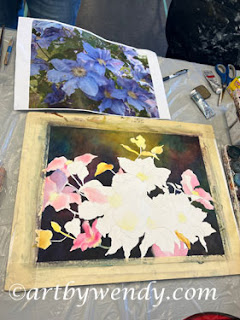
Getting started on the Background


My art group arranged a 2 day workshop with Marney-Rose Edge, a well known local artist, known for her work in florals.  Marney creates florals with deep, warm, dark backgrounds.  Her work seems to let you see into the depths of her flowers and the background of her pictures.  It was a joy to work with her.  

Marney likes to start with the background.  

In this case we were planning to create a dark background that was luminous and had a great sense of depth.  So painting it first was the way to go.  It is painted in layers

Layer 1 
This is the really fun, free for all layer.  Get your colours down and rich and pretty.  You can be loose here but make sure you keep them apart.

More layers on the Background 


Layer 2
Time to tighen up a bit. This is when you begin to create your background depth.  Want leaves, make some greens. Want some flowers, make some purples.  This is where your transparent colours shine.  Putting a yellow over that bright green in the first layer makes for an interesting green.  Use a warm and cool yellow in different places makes for variety in the greens.  

Marney has her own formulas and this is where you need to pull out yours.  What are the colours you use.  What colours do you create by glazing over them?  
I found this an interesting exercise.  Certainly I do a lot of glazing in my work but never really looked at it that carefully.  Putting darker colours as the bottom layer really changes what happens when you paint a thin layer of another colour on top.  

Really pushing it to the Dark Side 


Layer 3
Pushing back and getting dark.  This is a real game changer.  Painting over all the colour with a dark glaze of Payne's Gray is scary and final.  You are not getting much of that bright colour back.  However, you can see some of those colours below - Luminous Depth.

Painting the flowers was a very similar process.  Underlying colours were put on.  They dried and then new colours were created by using glazing techniques.  

Blocking out the flowers with underlying colour

My Take-Aways for success . . .

1. Don't fiddle when you are glazing.  Easy to do I know. But when you are painting a colour overtop of another colour you have to have a wet soft brush.  One or two swipes is all you get.  You fiddle and you start to lift the underlying colours.  Good bye Depth, hello Mud.  

2.  You need to use transparent colours.  These colours allow you to see the white of the paper through them when you paint.  Opaque colours block out the white of the paper.  So when you paint over a colour you can still see a bit of the colour underneath. Now you have a reason to recognize the different between opaque and transparent colours.  

3.  Have a test sheet handy.  The test sheet needs to be the same kind of paper you are working with.  Use it to test your colour strength and to see what happens when you paint over a colour with a thin layer of a different colour.  This is where the magic happens.  Test your favourite colours and see what works for you.  Mixing colour on your paper leads to lots of interesting variations.  

My Clematis WIP- Note the colour in the flowers from the different colours under and glazed over. 


I haven't finished my picture yet and I may not.  I like having the different stages there so I can see how they are affected by the layers.  I like glazing and use it alot with my birds and animals.  This class really pushed me into some new colours and to experiment more with my favourite ones. 

Have fun with your experiments and see you soon. 

Outdoor Sketching Classes Starting in Mid-May:  

Outdoor Sketching Classes are 2.5 hr sessions and located in parks in North Surrey and North Langley.  Beginners to Advanced are Welcome.  Mediums supported: watercolour, pen, pencil, watercolour pencils and coloured pencils.  You can sign up to as many sessions as you like.  Class Size: Max 3.  $50 per session.

Contact Wendy to get on my Early Registration List 


 Move your work to NEW LEVELS?  

Contact Me for:

1. Private Drawing Lesson: (3 Sessions 2.5 hr each $250)  North Langley, BC (Walnut Grove) 
Do you want your animals to breath, your flowers to sparkle or your people to walk?  Whatever subject your like to paint or draw I can build a drawing program for you.  Private Lessons allow you to focus on the skills you wish to develop.  Wendy is a experienced teacher, providing a calm, relaxing experience as you learn how to use the principles of drawing.  Beginner to Advanced are welcome.  Special rates for younger students.  More info here.

2.  Online: Teaching, Mentoring or Critiquing Your Work - Don't live in the Fraser Valley,  I would be happy to tailor a program just for you online.  Drawing and Painting Lessons, Mentoring you on your Art Journey or Critiquing Your Work with an Eye to Move It Forward.  Drawing & Painting Lessons: 2-30 sessions $75.  Mentoring or Critiquing 30 minutes sessions $25.  Flexible schedule and sessions can be longer or shorter depending on your goals. 

3.  Available at Art by Wendy's Studio
Original work, Commissions, Prints and Cards of her Work, 

Be sure to like and share my posts.  You won't miss a single post if you Follow by Email 
Have a great Artful Day,
Wendy

Feb 13, 2020

Painting with Dirty Water - Painting and Drawing Tips

OMG!  It was my turn to putt.  
Fast greens, sloping to the left, 10 ft to the hole.  Not easy.  

 There was no way I could use a full swing.  Not even a half swing.  Or a quarter swing.  We're talking only a nudge.  Then wait and hope. . .   
Isn't that just like painting with dirty water?. . . .

PICK OF THE HERD - Watercolour. Matted to 16 x 20, $500

When painting with watercolour there are all kinds of way to describe the mix of pigment to water. A really thick mix, so dry it barely moves. A rich creamy mix like thick cream. (The full swing)  A slightly thinner mix like milk. (The half swing)  Then there is the thinner mix like weak tea - the quarter swing.  But dirty water, that is a very thin mix of pigment to water - THE NUDGE.  

Looking at my horses in 'The Pick of the Herd" you might think I definitely didn't need dirty water to paint them.  But actually you might be surprised.  There were times when I was glazing, when I did want to nudge the colour a bit and soften the edges.  Take a look at the background.  That was definitely a case of Dirty Water.  Dirty water has many uses in the painting world.  (See last post 'Secrets they never told you about glazing with watercolour'.

Notice the test area for my Dirty Water in the background between the horses legs.  

How do you make Dirty Water?

Seems easy enough. Mix a bit of pigment with lots of water and away you go.  I find that having the right mixing space really makes a big difference.  Mixing colours in my palette is fine when I want darks but the subtle light shades can become tinted so easy: bits of pigment in the crevices of the palette; drops of pigment as I move across the palette; colours running from other areas. Not what I want.

Dishes are great to mix colours - note how you can have 2 colours and blend them in various strengths. 

My favourite mixing trays are . . . .

From the Dollar Store.  They have nice little white porcelain plates 3.5 x 3.5 inches square, that are great.  My paints don't bead up, they mix or separate as they want, I can may big puddles or small, and have two colours mixed several different strengths on one little plate.  They are easy to clean when I want  free clean spot to mix on.  They come in different shapes as a lot of them are little sushi dishes. They are awesome for mixing dirty water in large or small quantities.

My dirty water puddle.  Remember watercolour dries lighter and will also be diluted more when used wet into wet. 

Painting my Background with Dirty Water . . .

In my picture 'The Pick of the Herd', I wanted the silver grays of  the Thompson Plateau area in early spring.  The horses are out on the range which is warm and arid in summer but after the snow it is silvery grays as the ground wakes up for spring.  I wanted to tell that story.

Putting water down first I painted my subtle light grays over the area.  While things were still wet I added slightly darker colours to suggest shrubs and bushes. Painting wet into wet meant I would have soft edges and using Dirty Water, kept all the colours muted.  I used the same colours as I used on my horses and fences. After everything was dry, I used some dry brushing to put some foliage around the horses. 

Further Reading:
Get Those Values Working for You - looks at how values can bring your work depth and mass
6 Stories Your Edges Tell - Looks at the story your hard and soft edges tell in a painting


Art by Wendy Studio/Gallery is always Open


Looking to move your Drawing Skills to the Next Level?

Book a 3 Pack of Private Lessons with Me - 3 Lessons 2.5 hr each $225
Drawing/Painting lessons in graphite, ink, watercolour, watercolour pencils or coloured pencils Or any combination of these.
Flexible Schedule, at my Studio/Gallery, N. Surrey. 
Gift Certificates Available 


February is Marketing Month for Artists!!

Each February I offer an all day workshops “Let’s Get Your Art Out There!!”
2020 Date: February 23, 10-3pm
Having trouble getting started or knowing where and what to do?
This workshop gets your Marketing Plans fired up to new and more successful levels. Learn the basics of today’s Marketing World, learn how to develop markets both online with Social Media and off line in your community, learn how to develop a productive network, and set up a Marketing Plan that will work for you. Taking this workshop is a valuable step in moving your business forward. Workshop runs 10-3:00 pm with a lunch break.    Class limited to 8 people  2 Spots Left
Cost $90 + Tx       Pre-Registration Required, contact Wendy      Gift Certificates Available
Save the Date . . . . .
March 6-8, 2020 - The West Fine Arts Show.  Peter Ewart Middle School, 7755 202A St, Langley BC.  Yes, I have teamed up with this great show event: 20 Professional Artists, Awesome Art, a show you shouldn't miss.  


My Etsy Store is always OPEN: Etsy - WendyMouldsArt

Originals, Prints, Commission Work and Instant Printable Cards for all Seasons available.

Be sure to like and share my posts to keep me coming into your box, 
You won't miss a single post if you Follow by Email or Like my Facebook Page.
Have a great Artful Day,

Wendy

Feb 6, 2020

Secrets they never told you about Glazing with Watercolour - Painting & Drawing Tips

How did you learn to paint?
Few classes. Few books. Some YouTube. Lots of Practice.
That's how I learned too!

PICK OF THE HERD - Work in Progress #3 - Watercolour 12 x 16. 

Really its a never ending journey, there is always more things to do and try.  I must admit glazing wasn't really something I spent a lot of time with. The book said put down yellow, glaze with blue and you got a green.  So what? Now I know, different.

They didn't tell me the Secrets . . .

There is way more to glazing then getting a different shade of green.  

When I create my birds and animals I like them to be similar to my drawings.  Very lifelike. Feathers and fur soft to touch.  With a deep sense of realism.  In order to do that in graphite, I need to work in layers.  When I moved to watercolour I realized I needed to do the same thing.  Layers.  Lots of layers. 

Suddenly, I was in the World of Glazing and didn't even realize it.  As I was blending my edges, fighting to get the right colour, I accidentally glazed.  Ooooh!  You are probably thinking.  Maybe I do that too. 

What is glazing?
Glazing is putting a light layer of wash over another colour that is dry.  The result is a colour change to the initial colour.  Usually this is done with transparent colours.  The result is a very transparent look.  (ie.  the light goes through the pigment to the paper and there is a shine to the area.) 

But there is more to glazing than the transparent look . . . 

WIP #1: Under-painting for the body - Wet onto dry.  (not sure why I did the head first, I just did. A funny place to try out my colours but  . . )

Check out the under-painting for 'The Pick of the Herd'.  Notice the 3 different areas of his body.  I put down only a base colour that I wanted to shine through. 

Did you know purple glazed over orange equals brown?

And really interesting browns too.  A red purple gives a much different look than a blue purple. (Of course you have to use a mixed purple rather than one straight out of the tube.)

Once I had my base down, I glazed over the areas with different colours.  At first I glazed with my warm yellow orange, to darken the colour. Then I started to lay out the markings with darker colours.  Then more glazing. 

Why all this glazing?

1.  Transparency: I wanted my horse to have a transparent look.  It seems to give my animals a great sense of mass.  I also really like that look.  To me his heightens the realistic look I am seeking.

WIP # 2 - Building up the layers on the neck and mid section of the horse.  Not the strong red glazed on to the front leg and the lower stomach.  
2.  Blending: The colour transitions on an animal have to be smooth and blended.  By putting the markings on early, it allows the many layers on top to smooth those edges.  You can see that the markings on my horse have a smooth transition from dark to light.

3.  Add tints of colour: My horse has a redish tone to his coat and I wanted that in the final results.  So on many of the transition points of light to dark, I glazed with a red. Light glazes of course.  This gave rich redish tones to my golden yellow area.  You can see this in the 2nd WIP picture of my horse. 

4. Darkening Colour: Of course you can also just keep glazing with the same colours.  This will make your colour darker but also gives it a rich tone.  The transparency quality gives it depth, giving the horse's hide a softness that makes you want to touch it. 

As you work with glazing you will probably think of other ways you use it.  It can be in big areas or small.  For me though,  these are the big 4 ways I use it. 

Side Notes:
- It takes many layers to build up your colour. 
- Because you are working wet onto dry, you must wait until the layers below are dry.  Patients is needed.  I work in other areas of the picture while I wait, work on a drawing or fold the laundry. 
- You can't fiddle.  One or two brush strokes then move on.  If you 'work an area' with too many strokes you will lift the paint underneath.  Remember, you are only putting on a light layer of pigment so let things dry and try again. 
- My Palette for the main horse:  Ultramarine Blue, Permanent Rose (for my purple); Quinacridone Gold, Burnt Sienna, Indian Red (a new colour I was trying out)

Try some glazing.  It is really amazing how you can change colours. 

Further reading:

Step-by-Step Glazing with Watercolour - a detailed look at how the layers are added
The Secrets of Watercolour Paper - a look at different types of paper and how they will perform when glazing and other types of painting with watercolour.
Watercolour Over Glazes - John Lovett - interesting different colours to glaze with and other uses for it. 
Transparent and Opaque Watercolour - DeviantArt - a good discussion on the what and how they can be used.

Art by Wendy Studio/Gallery is always Open

Looking to move your Drawing Skills to the Next Level?

Book a 3 Pack of Private Lessons with Me - 3 Lessons 2.5 hr each $225
Drawing/Painting lessons in graphite, ink, watercolour, watercolour pencils or coloured pencils Or any combination of these.
Flexible Schedule, at my Studio/Gallery, N. Surrey. 
Gift Certificates Available 

February is Marketing Month for Artists!!

Each February I offer an all day workshops “Let’s Get Your Art Out There!!”
2020 Date: February 23, 10-3pm
Having trouble getting started or knowing where and what to do?
This workshop gets your Marketing Plans fired up to new and more successful levels. Learn the basics of today’s Marketing World, learn how to develop markets both online with Social Media and off line in your community, learn how to develop a productive network, and set up a Marketing Plan that will work for you. Taking this workshop is a valuable step in moving your business forward. Workshop runs 10-3:00 pm with a lunch break.    Class limited to 8 people  3 Spots Left
Cost $90 + Tx       Pre-Registration Required, contact Wendy      Gift Certificates Available

Save the Date . . . . .
March 6-8, 2020 - The West Fine Arts Show.  Peter Ewart Middle School, 7755 202A St, Langley BC.  Yes, I have teamed up with this great show event: 20 Professional Artists, Awesome Art, a show you shouldn't miss.  


My Etsy Store is always OPEN: Etsy - WendyMouldsArt

Originals, Prints, Commission Work and Instant Printable Cards for all Seasons available.

Be sure to like and share my posts to keep me coming into your box, 
You won't miss a single post if you Follow by Email or Like my Facebook Page.
Have a great Artful Day,

Wendy

Sep 12, 2019

Watercolour- Really?? Wet by Wet? - Painting by Drawing Tips

No, Not a Misprint - Wet by Wet, is a Watercolour Technique


POPPIES, FULL OF LIFE - watercolour mounted on wood cradle, 14 x 22 inches, $850

Painting watercolour wet into wet is the norm and certainly a technique most watercolourist employ at some point in their work.  I certainly struggled with this method many times as I learned to paint.  And yes, it is now something I do in my work.  But the more I painted the more I realized it doesn't tell the whole story.  Working with my latest picture, Poppies, Full of Life, I realized I really wasn't working wet into wet. . .

I was working wet by wet.

In the true sense of the wet into wet technique, you mix the colours on your paper.  Adding one colour to the other when they are wet.  The colours will mix, or not, depending on the pigments as they move about the space.  They will certainly give an array of  colour you can not get with a simple brush strokes.  Definitely, one of the reasons why watercolour is such a special medium.

So what is Wet by Wet?

Paper is wet, a colour is down but the new colour is added beside the other colour, not into it.  Sounds easy enough but as you know, when it comes to matching water and pigment, nothing is that simple in watercolour.  


Wet by Wet - notice the space between the colours and the bleeding of colour into the neighbouring one.
Close up from - Poppies, Full of Life

In my Close Up from Poppies, Full of Life, you can see how the new darker green pigment is being added to the area around and into the lighter green and but only close to the red poppy suggested in the background. Notice how the pigments bleed together making a soft edge but still keeping their own areas of colour.  This is the big difference between Wet into Wet and Wet by Wet.  With Wet by Wet, the two neighbouring colours are not changed only their edges are affected.  (See more on the painting of the background of Poppies, Full of Life on my last post, here)

This 'softness' is the key . . . . 


Poppies Full of Life - WIP - notice how the edges within the poppies are soft (middle flower) and the edges in the background are all soft

Why the soft edge?

A soft blended edge is needed in many places within a painting.  Looking at Poppies, Full of Life - WIP you can see it:
1.  In the background to suggest leaves, branches, other blossoms
2.  Within the blossoms to suggest petals, shadows, highlights
3. Within the leaves and buds to give a gradual colour change rather than a sharp one.

Special Note: In this particular painting, I particularly liked the loose, plush look of my flowers which is a different look to one that is created through layers of glazing.  I did some glazing later to add the deep shadows and define the markings.  


Close up of blossom BEFORE final glazing for shadows - Note the loose, plus look the blossom has.  Only needed to add the shadows with a bit of glazing. 

How to do Wet by Wet . . .

Okay, now you are not going to be very happy.  This technique is a balance of water, pigment and doing a single stroke.  This is a no 'fiddle around' technique.  (You know,  you touch the brush again and again to an area, rather then one stroke and leave it - Fiddle Around) You will need to practice this technique a lot,  to get the balance of water and pigment correct.  Also, when using new colours, I would suggest doing a little test first.  You never know when your pigments might have their own idea when they touch.  

Things to note:
1. Works best on good watercolour paper. I use Arches 140 taped down
2.  Paper is wet but not sopping and warped.  
3.  Brush is wet but not dripping
4.  When you touch the paper with the brush the pigment moves out slowly not spreading quickly
5.  Let things dry naturally, no blow dryer.
6.  The amount of pigment on your brush is determined by what you are painting.  You only get one swipe so make it a bit darker than you think as your paint dries lighter.
7. Work quickly as your paper/paint dry quickly
8.  To wet your paper if too dry, use a fine mist over a larger area than what you need. 
9.  Apply paint with as few strokes as possible (no Fiddling) 

Lots to think about I know, but worth the practice.  I find I use this technique in some form all the time in my work.  Keep at it.  You will be happy when you have it.  

Other things you might be interested in:

Using Glazes to Finish the Background

The Secrets of Watercolour Paper

Painting those Pesky Backgrounds

Looking to move your Drawing Skills to the Next Level?

Contact Me to Register ↓↓↓↓
Upcoming Drawing Classes: 

Sunday, September 22 & 29, Beecher Place, Crescent Beach, S Surrey. 1-3pm. $40 ea.
Part 1: Get that Line Drawing Right - Sept 22
Part 2: Values, Light & Shadows - Sept 29
Beginners to Advanced Welcome.  Come to one or both.      
Drop-In and Draw
Monday, September 30, 1-4pm Beecher Place, Cres. Beach $20.  Get tips on old projects or new. 


Contact Wendy to Register and for more information.  

OR Book a 3 Pack of Private Lessons with Me - 3 Lessons 2.5 hr each $225
Based on your Schedule at my Studio, N. Surrey. 

September 19-30 I will be at Beecher Place with Art Theo featuring Art by myself, Doris Biddle and Donna Schipfel.  During our stay we will be offering classes and showing/selling our work. I have Drawing Classes on the Sundays (Sept 22 & 29)  and a Drop-In Session (Sept 30)  for those that want to practice more from the classes or would like help in their own projects or starting new ones.

Doris will be offering a 2 Day class working with Acrylics $80 and a Ceramic Painting class $45.  Donna will be offering 2 classes on Watercolour on Rice paper $40 ea.

FYI
I am scheduled for a Demo at Opus this fall: 

 Drawing: Values, Light & Shadows Saturday, Oct 19, 11-12:30 or 2-3:30 Free 
Contact Langley Opus to Register  604.533.0601


My Etsy Store is always OPEN: Etsy - WendyMouldsArt

Originals, Prints, Commission Work and Instant Printable Cards for all Seasons available.

Be sure to like and share my posts to keep me coming into your box, 
You won't miss a single post if you Follow by Email or Like my Facebook Page.
Have a great Artful Day,

Wendy